

Not a Makoto+ member yet? Join today and unlock a world of Japanese-learning goodness! Start with our free tier—no strings attached—or level up to Samurai or Shogun status to get the monthly magazine plus about a billion (give or take) times more content including access to our new iPhone and Android app to supercharge your studies.
笑門来福: An Evening of Rakugo with 桂三輝
About a year ago, a Japanese friend sent me a video of a foreign rakugo artist and said, “You’ve got to watch this.”
The artist was Katsura Sunshine.
Last week, we had the honor of seeing him perform live in Tallahassee (we currently live in Florida). On the drive home, Yumi turned to me and said, “I feel like I’ve been cultured.” She meant it in the very best way. I REALLY wanted to point out that we also say this about yogurt.
The Second Foreigner in Four Hundred Years
桂三輝 Katsura Sunshine is a Canadian rakugo storyteller. In 2008, he was accepted as the 15th apprentice of 桂三枝, one of the most famous rakugo performers in Japan and, on TV, the host of 新婚さんいらっしゃい!, which Guinness certifies as the longest-running talk show with the same presenter. He interviewed newlyweds every Sunday for fifty years, then handed over the desk and kept doing rakugo. (Sunshine-san’s master later inherited the grand name 六代桂文枝, Katsura Bunshi VI, in 2012. Rakugo names are passed down like heirlooms, but that’s a topic for another letter.)
The apprenticeship is the old-fashioned kind: three years of living at your master’s beck and call, folding kimono, carrying bags, making tea, and absorbing the art by osmosis. In the set we saw, Sunshine explained being an apprentice meant doing laundry and that is why he now has four apprentices! Sunshine folded his last laundry in 2011 when he completed his apprenticeship and began taking on apprentices of his own.
Here is how rare this is (a foreign rakugo master, not the not doing laundry bit): he is the first Westerner ever in the 上方 tradition, the Osaka school of rakugo, and only the second non-Japanese professional in the entire 400-year history of the art. The first was 快楽亭ブラック, Henry Black, an Australian-born Brit who performed through the Meiji era and became so thoroughly local that he died a naturalized Japanese citizen.
Four centuries. Two foreigners. I missed seeing the first one, but I sure as heck wasn’t going to miss #2!
One more thing: Sunshine moved to Japan in 1999, a year after I did. Sadly, only one of us ended up on Broadway and it wasn’t me. (Sunshine-san splits his time mostly between Tokyo and New York. If you are near either, plan your trip around his performances.)
寿限無
Before I explain what rakugo actually is, watch him do a bit from the most famous beginner’s story in the repertoire, 寿限無:
The premise of Jugemu is simple. New parents want a lucky name for their baby boy, so they ask the local priest, who rattles off a long list of auspicious options:
- 寿限無 (“life without limit”),
- 五劫の擦り切れ (a span of time so long a rock wears away before it ends),
- and on and on.
Unable to choose, the parents use all of them. The boy’s full name becomes:
A word about that 五劫. One 劫 is the time it takes a 天女, a celestial maiden, descending once every three thousand years, to brush a mountain-sized boulder with her robe until the rock wears away to nothing. Jugemu’s name contains five of them. His parents did not so much choose a lucky name as a unit of geological time. (Read all about the 天女 celestial maidens in volume 12 of our Learn Japanese with Stories series.)
The running gag: every time anyone needs to say his name, disaster has time to mature. In the classic version, Jugemu bonks another kid on the head, and by the time the victim finishes reporting the crime (full name, twice) the lump has healed and the evidence is gone.
In older tellings, the ending is darker: Jugemu falls into the river, and by the time the neighbors finish announcing exactly who fell in, there is no longer anyone to rescue. Edo audiences, apparently, liked their punchlines with a body count. The bump on the head is the family-friendly patch.
It is, in other words, a 300-year-old joke about parents who couldn’t make a decision.
The name is still a national institution, by the way. NHK’s children’s show にほんごであそぼ (“Let’s Play with Japanese”) turned the full recitation into a childhood rite of passage. Japanese kids rattle off Jugemu the way math geniuses show off digits of pi. (Longtime readers may remember our Makoto Letter on memorizing pi with 語呂合わせ. Read that letter here.)
Which brings me to a confession. Many years ago, inspired by the にほんごであそぼ (“Let’s Play with Japanese”) show and back when I had hair, I picked up my toddler son, pressed record, and recited Jugemu’s entire name at him:
That toddler is an adult now. Thankfully, when we chose his name, I had not yet heard of Jugemu. Makoto it was, and a one-word name it remains. (Yes, that Makoto. I only had the one good idea and I’ve been reusing it ever since.)
So What Is Rakugo?
落語 is written with two kanji:
- 落ちる — to fall, to drop
- 語る — to tell; 語 on its own means “word” or “speech”
“Falling words.” The “fall” is the 落ち (also called サゲ), the punchline that drops at the end of every story. The entire art form is literally named after its punchline. Imagine if English speakers had called stand-up comedy “The Punchline Arts.” That’s rakugo.
A few things worth knowing:
It started with a monk. The usual founding figure is 安楽庵策伝, an Edo-period Buddhist priest who discovered that parishioners stay awake for sermons that end in a joke. His collection of humorous stories, 醒睡笑 (roughly, “Laughs to Wake You Up”), became a wellspring for later storytellers. Rakugo may be the only comedy tradition on earth that began as a strategy for keeping people conscious during a sermon.
Every story starts with a pillow. Not a literal one. Well, there is a 座布団 (cushion), which is like a pillow, but a pillow for your bottom. Every performance opens with casual chatter, a personal story, something to warm the room before the main tale begins. That opening stretch is called the 枕: the pillow. And if you have been wondering why this letter opened with a video suggestion from a Japanese friend and something about yogurt instead of a definition, that was the makura. I did it on purpose. Okay, it was totally an accident, but there you go: 枕.
The prop budget is two items. A rakugo performer sits in 正座 (which Sunshine-san translates into perfect English as “PU-NISH-MENT”) on a cushion (座布団) for the entire performance and plays every character (old men, young wives, samurai, drunks) using only voice, posture, and a turn of the head. The complete prop inventory: a folding fan (扇子・せんす) and a hand towel (手ぬぐい). The fan becomes chopsticks, a pipe, a sword, a writing brush. The towel becomes a book, a wallet, a bowl. Four hundred years of comedy, and the entire equipment list is available at Daiso for just over 200 yen (with tax).
There are two schools. 江戸落語, the Tokyo tradition, and 上方落語, the Osaka tradition Sunshine belongs to. Kamigata rakugo grew up on the streets, competing with crowds and noise, so it’s flashier; performers may use a small desk (見台・けんだい) and wooden clappers to punctuate the story. Tokyo rakugo grew up indoors in 寄席 theaters and plays it a bit cooler. The Osaka–Tokyo rivalry, it turns out, predates baseball. One more wrinkle: Edo rakugo has a formal promotion ladder of 前座 (opening act), 二つ目 (second billing), and 真打 (headliner), while Kamigata did away with ranks altogether. In Osaka, you are only as good as your last laugh.
Back to the Show in Tallahassee
We arrived an hour early and we had our choice of any seat. My daughter campaigned energetically for the back row (tail-end teenager, you know what I mean). I invoked parental authority, a power with a rapidly approaching expiration date, and we sat front and center. The cool-kid-grumpy look my exercised parental authority caused turned into uproarious laughter. She even admitted she had a great time. And if she forgets, I have photographic evidence that she did.
Before he came on, I snapped a photo of the stage. (I hope he didn’t mind.)
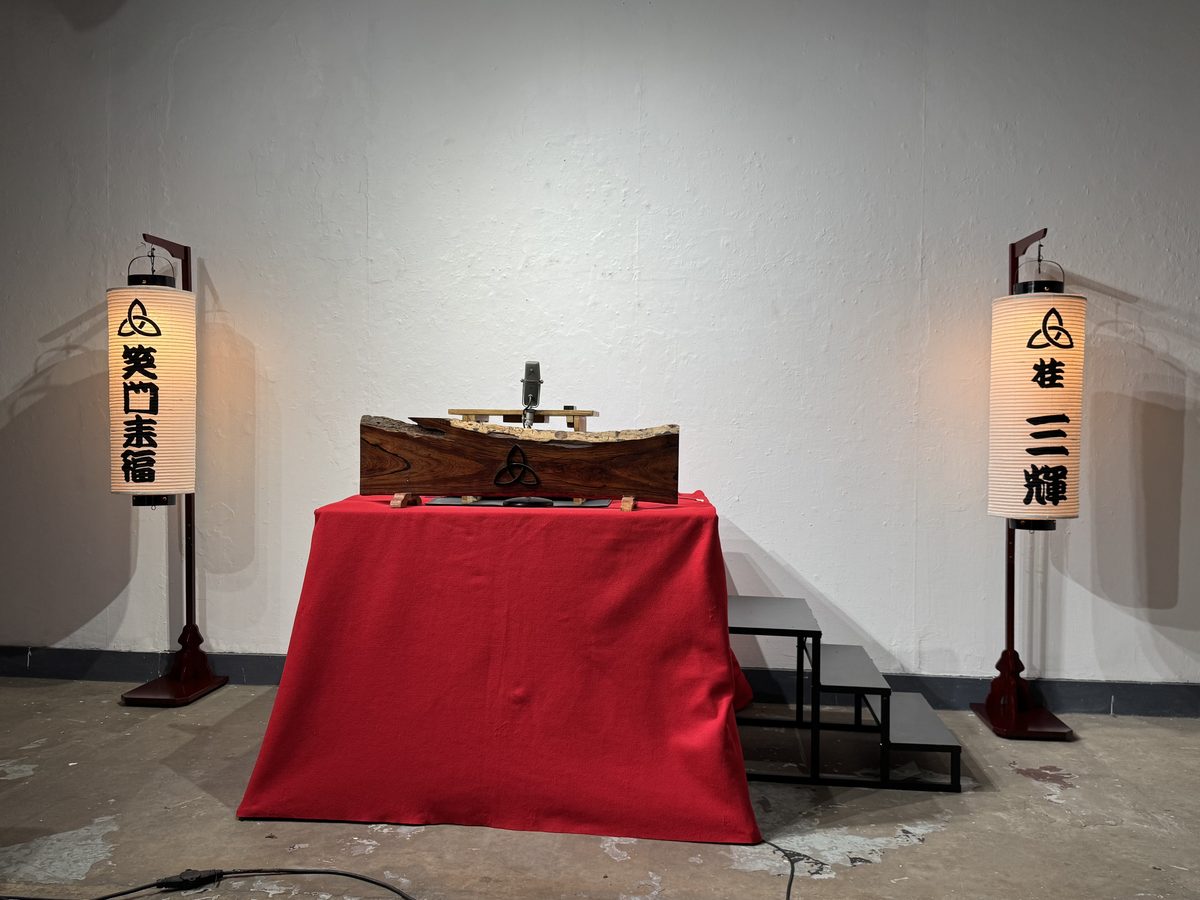
Notice the two paper lanterns, 提灯. They’re not decoration. They’re both saying something.
The lantern on the left (stage right) reads 笑門来福:
- 笑(しょう/わら・う) — laugh
- 門(もん/かど) — gate; here, household
- 来(らい/く・る) — come
- 福 — good fortune
“Fortune comes to the home that laughs.” It’s the compact, four-character version of the proverb 笑う門には福来る. Note that 門 in the photo looks like a stylized 口 mouth but it is 門, and this “gate” isn’t a literal gate; it’s the old sense of “house” or “family.” Hang that on a rakugo stage and it’s less a proverb than a mission statement.
The lantern on the right has his name, 桂三輝, and every character is working overtime:
- 桂 — This is the 亭号, the “house name” of his rakugo school, shared by everyone in the 桂 line. Think of it as a guild surname, passed from master to apprentice.
- 三 — Apprentices of 三枝 receive 三 in their names. One kanji, and everyone in the rakugo world knows exactly whose student you are. It’s a family crest you can pronounce.
- 輝 — “To shine.” Normally read き in names, but here it’s given the English reading シャイン as ateji.
Put it together: 三 + 輝 = サンシャイン. Sunshine. His master built a bilingual pun directly into his student’s professional name. When your teacher is one of the funniest men in Japan, apparently even your name gets a punchline.
落ち
After the show, we got a picture with him.
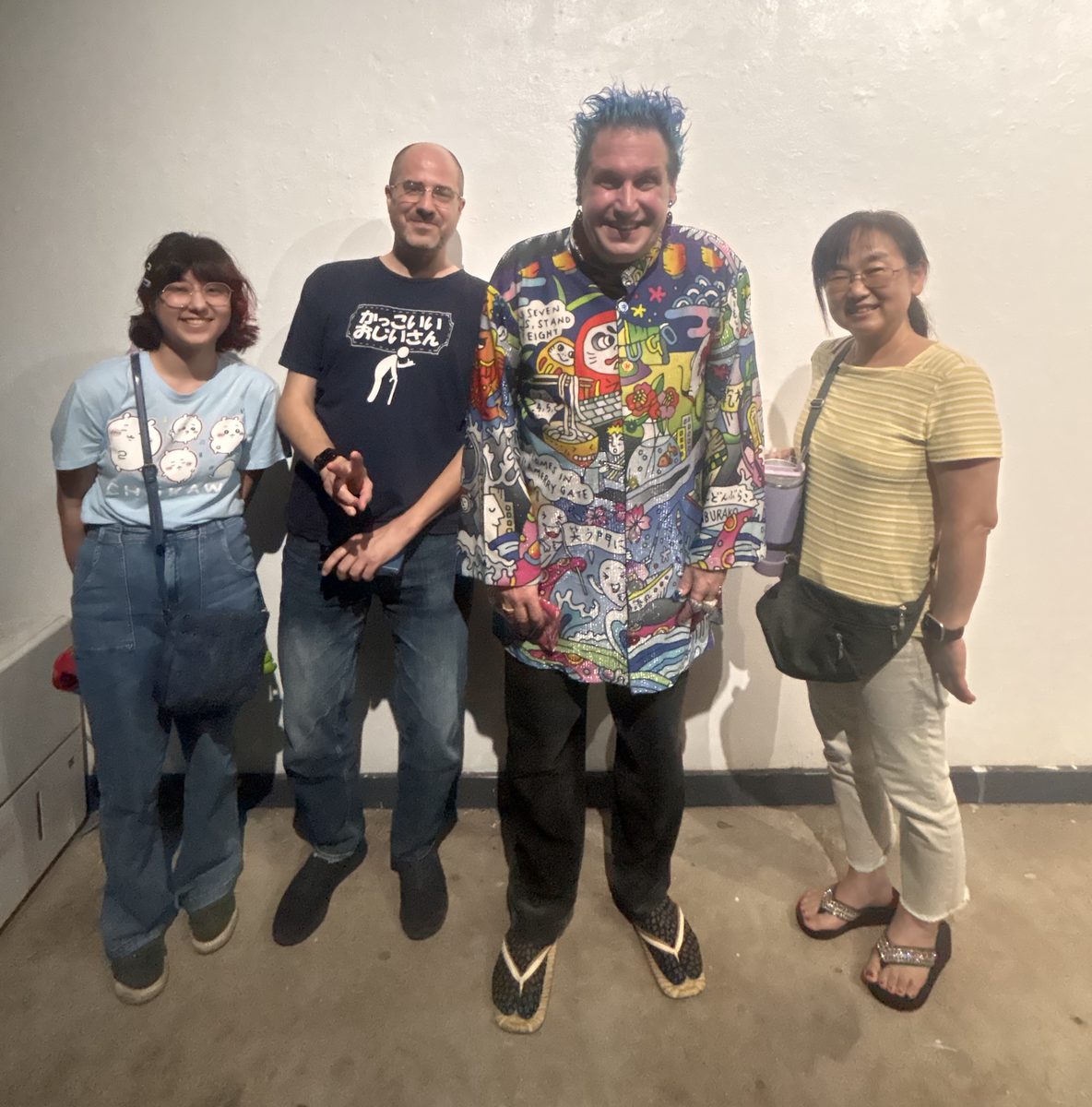
The lantern turned out to be an accurate omen. 笑門来福. We laughed for an hour and a half, and I’d call that fortune.
If he comes anywhere near your town, go. And if you can’t wait, his YouTube channel and his Broadway/West End shows are the next best thing. Tell him a bald guy with a hopeless sense of humor from Florida sent you.
- Website: rakugo.lol
- YouTube: @KatsuraSunshineRakugo
- Instagram: @katsurasunshine
Until the next letter,
Clay
P.S. After the show, I sent a LINE message to the Japanese friend who started all this with “You’ve got to watch this.” I reported that I had told the man himself that it was she who introduced me to his videos. She said she wasn’t sure if she should feel honored, but she was honored nonetheless. Four hundred years of rakugo, and it still spreads exactly one way: a friend insisting you’ve got to watch this on YouTube.
P.P.S. Rakugo law requires every story to end with a 落ち drop, so here is mine. This letter’s full name is: An Evening of Rakugo, An Evening of Rakugo, Five Kalpas of Proofreading, the Sunshine of Tallahassee, the Lantern of Incoming Fortune, Paipo Paipo Paipo’s Newsletter, Shūringan’s Second Draft, Gūrindai’s Missing Comma, the Long-Life Long-Letter of Long-Winded Clay. By the time you finish saying it aloud, the next letter will already be out.
Not a Makoto+ member yet? Join today and unlock a world of Japanese-learning goodness! Start with our free tier—no strings attached—or level up to Samurai or Shogun status to get the monthly magazine plus about a billion (give or take) times more content including access to our new iPhone and Android app to supercharge your studies.