

Not a Makoto+ member yet? Join today and unlock a world of Japanese-learning goodness! Start with our free tier—no strings attached—or level up to Samurai or Shogun status to get the monthly magazine plus about a billion (give or take) times more content including access to our new iPhone and Android app to supercharge your studies.
とぐろ and どくろ
The other day I was reading a mystery novel when I hit this line:
蛇がとぐろを巻いていた。
A snake lay coiled up.
I knew what it meant. But とぐろ (coil) honestly isn't a word I use often, and if someone had burst into the room shouting, "Quick, Clay, what's the Japanese word for 'coil,' as in a snake all coiled up?! Hurry up, this is life and death!!"—well, I'm sorry to say that person probably wouldn't have made it.
But now? I could save them. Yes, Clay now can recall the word for “coil” in Japanese on demand and save lives with that knowledge.
Here's why.
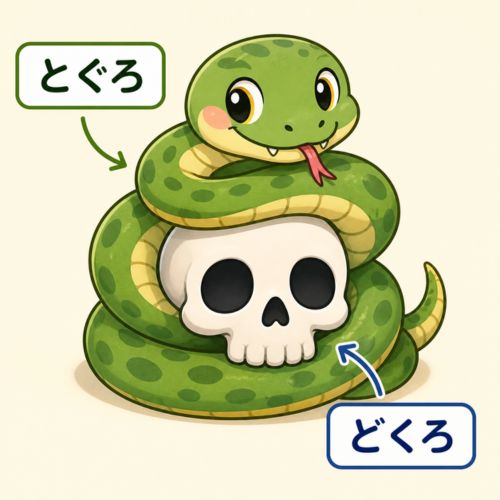
Looking at とぐろ sitting there in the digital ink, I noticed something. It has the same kana shape as どくろ, which means "skull."
Yes, today's lesson is a touch grim—life-and-death emergencies, skulls, coiled snakes. Stick with me. There's a point.
The two words share the same hiragana; only the 濁点 —those "ten ten" marks that turn an unvoiced consonant into a voiced one—shift positions:
- とぐろ (coil) — voicing on the second syllable
- どくろ (skull) — voicing on the first
Etymologically these two have nothing to do with each other. とぐろ is native Japanese; どくろ (髑髏) comes from Chinese. But for my purposes, that's a feature, not a bug. The accidental resemblance gave me a hook.
The Romeo Mnemonic
Years ago, I learned どくろ (skull) with this story:
A skull became a skull because Romeo drank どく (poison) upon seeing Juliet dead. どく + ろ (for "Romeo") = どくろ.
Boom. Skull, learned. Let's pause and celebrate the moment.
…
Okay, that's long enough. Honestly, I haven't had much occasion to use どくろ in conversation since. Which is probably a good thing.
But once どくろ (skull) was locked in, all I had to do was picture a snake coiled around a skull, and とぐろ (coil) slithered right into place. Two words for the price of one weird little image.
The Actual Point
"Skull" and "coil" probably aren't burning a hole in your vocabulary study list. That's fine. The point isn't the words.
The point is that this technique works. The weirder, more personal, and more ridiculous the story, the better it sticks. Romeo drinking poison doesn't have to make sense to anyone but me. It just has to make sense to me. That's the whole trick.
Try it with a word you keep forgetting. Make a story that's silly, embarrassing, or oddly specific—the kind of thing you'd never share out loud. Then notice, a week later, that the word is just… there.
Anyway. I now know how to say "the snake was coiled up." I'm ready for that mystery novel.
I'm also ready, apparently, for a very specific hostage situation.
Useless Bonus
"Clay," I hear someone saying, "I need more useless Japanese vocabulary!" 了解— Roger that.
Here's a bonus: a more literary, poetic way to say どくろ is しゃれこうべ. Same skull, fancier outfit. It's the word you reach for when you're holding one up like Hamlet, not labeling a Halloween decoration.
You know how kids sometimes hear a fancy word and confidently misuse it for years?
On a Japanese podcast/radio show we listen to (安住紳一郎の日曜天国), a listener wrote in with this gem from her childhood. She'd gotten it into her head that しゃれこうべ was a compliment for people from Kobe—after all, it sounds like おしゃれ (stylish) plus 神戸. Stylish Kobe person. Makes perfect sense, right?
So one day, when someone said something nice about Kobe, she nodded knowingly and said:
「さすが、しゃれこうべ。」That's Kobe for you… skull.
There was a pause. Someone gently explained what しゃれこうべ actually means.
Easy mistake. Could happen to anyone.
And now you know how to say “skull” in Japanese twice over. You are welcome.