

Not a Makoto+ member yet? Join today and unlock a world of Japanese-learning goodness! Start with our free tier—no strings attached—or level up to Samurai or Shogun status to get the monthly magazine plus about a billion (give or take) times more content including access to our new iPhone and Android app to supercharge your studies.
The Meaning of ございます
Even if you are a beginner, you should know these set phrases:
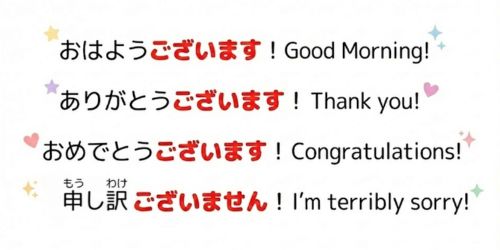
You hear these every single day in Japan. At the convenience store. At the office. In the elevator with your neighbor. They're so common they almost become background noise.
But have you stopped to think what ございます actually means?
A Look at ございます
It's a polite verb of existence — fancy talk for "is" or "there is." But that undersells it. Let's dig into the parts of this old word.
Written in kanji, it's 御座る:
- ご (御): Honorable
- ざ (座): Seat / Place
- ある: To exist
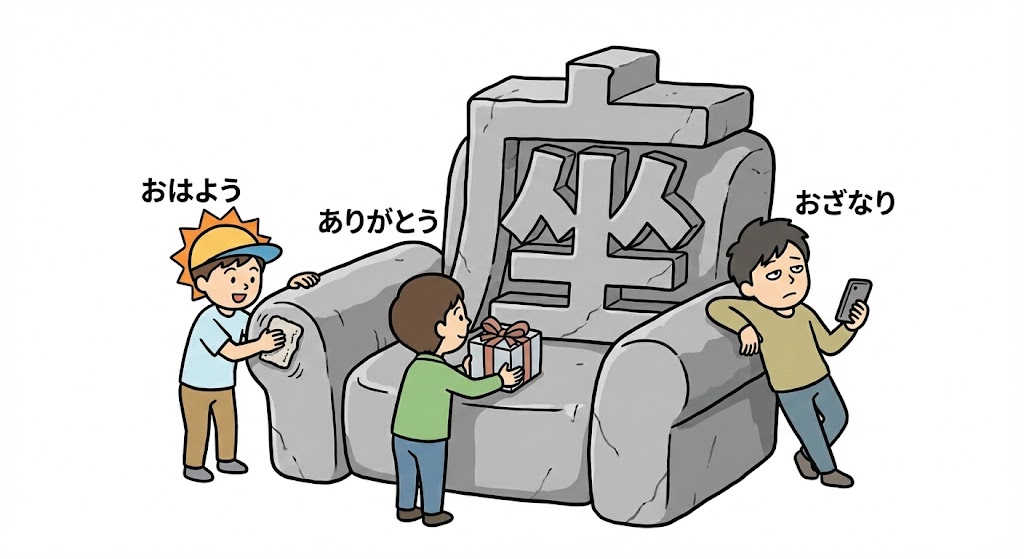
So... this literally means something like "to exist on the noble seat" or "to be present at the honored place"?
Yes. The 御座 referred to the emperor's or an aristocrat's seat — the throne, essentially. The original image is "being present where the honored person sits."
That reverence is baked into the word. It's why ございます still functions as the polite form of ある, centuries later. Every time you say ありがとうございます at the register, there's a ghost of an emperor's throne in there somewhere.
Set Phrases
Now, let's return to those four everyday phrases and see what's really going on inside them.
おはようございます — Good morning
早い (early) → はよう (old adjective form) + ございます (it is)
Literal meaning: "It is early." As in, "You're up early" or "It's early and here you are." A recognition of someone's presence at the start of the day. Not a bad way to greet someone, when you think about it.
ありがとうございます — Thank you
ありがたい (grateful/rare) → ありがとう + ございます (it is)
Written in kanji, ありがたい is 有難い — literally "difficult to exist." The idea: what you've done for me is so rare, it almost shouldn't exist. Add ございます and you get something like "It is a rare and precious thing."
That's a long way from "thanks," but that's the feeling buried inside it.
おめでとうございます — Congratulations
めでたい (auspicious/joyous) → おめでとう + ございます (it is)
めでたい comes from 愛でる (to admire, to celebrate). With the honorific お and ございます: "It is a joyous occasion." Birthdays, New Years, weddings — any moment worth marking.
申し訳ございません — I'm terribly sorry
申し訳 (excuse/justification) + ございません (does not exist)
This one flips the pattern — it uses the negative form. Literally: "There is no excuse." Not "I'm sorry" but "I have no justification for what happened." That's why it hits harder than すみません. There's nothing to hide behind.
Notice the pattern in the first three: they all take an い-adjective, shift it to that old ~う form, and attach ございます. This formula was once productive in the language but today only survives frozen inside these set phrases. Nobody walks around saying 美しゅうございます anymore. Unless you're watching 大河ドラマ (period show), in which case, everyone does.
The fourth one is different structurally — noun + ございません — but ございます is doing the same job: being the ultra-polite version of ある/ない.
Let's Talk About おざなり
I bring this up because, well, it's interesting. Whether you're a total beginner greeting someone with おはようございます for the first time or an old hand mimicking period drama lines, there's something satisfying about knowing what's actually inside these words.
But also because I came across a similar word the other day.
おざなり
おざなり means "perfunctory" or "halfhearted." It's most often used in phrases like:
おざなりな返事 — a perfunctory reply
Think of the teenager responding to his mother's command to clean his room:
"Yeah, I'll get to it."
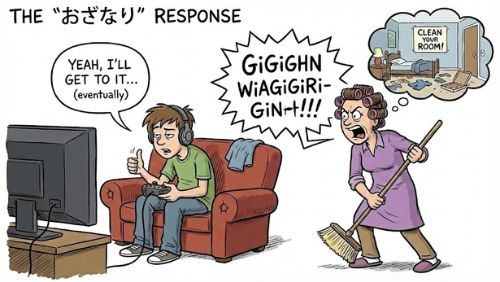
Translating from teenagese to English, that would be: "I'll pretend to have heard you, but I'm too engrossed in this video game to comprehend, and whatever you just said sounded like it was too much work anyway, so I'll try to placate you by responding with what I think you want to hear."
Or thereabouts.
That's a classic おざなりな返事.
Where was I going with this? Oh yeah, the kanji.
The kanji for おざなり is, lo and behold:
御座なり
"Wait a second," I hear you mutter, "didn't I see 御座 earlier?" Yes. Yes, you did.
Same two kanji as ございます just with a お pronunciation instead of ご:
- ご or お (御): Honorable
- ざ (座): Seat / Place
Naturally, this excited the Japanese nerd in me. Could these two words be related?!
The Connection or Lack Thereof
I did a few web searches and was quickly disabused of that idea.
For one thing, the two words are practically opposites:
- ございます — to be; to exist (polite, reverent)
- おざなり — halfhearted; going through the motions
Still, the etymology of おざなり was interesting enough to keep me going.
The 御座 in おざなり doesn't come from the imperial throne. It comes from お座敷 — the banquet tatami room.
And the なり isn't なる (to become). It's 形(なり)— "form" or "shape."
So 御座形 means something like "matching the shape of the gathering."
Here's where it gets good. In Edo-period banquets, there were entertainers called 幇間(ほうかん)— professional flatterers, basically. Their job was to keep guests happy. But they'd adjust the quality of their act depending on who was paying. Important patron? Full effort. Nobody special? Just go through the motions.
That "going through the motions" is where おざなり gets its modern meaning.
So the next time you give — or receive — an おざなりな返事, just know there's an Edo-period entertainer shrugging behind it.
Let's wrap this up with a sentence that ties the whole thing together:
御座なりな挨拶では御座いません。
心から、ありがとう御座います!
This isn't a perfunctory greeting. From the heart: thank you!
ありがとうございます
こちらこそ、ありがとう御座います!
Arigatou gozaimasu! (ozanari dewa arimasen!)
Haha! Glad you liked it.