

Not a Makoto+ member yet? Join today and unlock a world of Japanese-learning goodness! Start with our free tier—no strings attached—or level up to Samurai or Shogun status to get the monthly magazine plus about a billion (give or take) times more content including access to our new iPhone and Android app to supercharge your studies.
Japanese Family Names
My full name is John Clay Boutwell.

When I taught English in Japan, my parents came to visit and the principal invited them to view one of my classes. It was an elementary school group, and the kids were inquisitive.
「クレイ先生」(Clay Teacher) one of the students asked in Japanese,「名前は誰がつけたの?」 (Who gave you your name?)
「お母さんだよ」 (My mother did.) I replied, pointing to her standing right next to me. Then, still in Japanese, I explained that in slang, "John" means "toilet" (as in "I gotta go to the John") and "Clay" means, well, glorified dirt.
So, in a very real sense, my name means "dirty toilet."

The class burst out laughing—elementary kids, after all—which left my mother quite confused. But she played along, smiling and nodding.
Then one of the kids—the smart one, probably—looked at my mother, put two and two together, and realized:
- They were laughing about my "dirty toilet" name,
- My mother was the one who gave it to me,
- She was standing right there, and finally,
- This could lead to an international incident.

He scrambled to shush everyone.
The room fell into deep silence.
"What's going on?" asked my mother.
I explained (eventually) and, even today, we still laugh about that "international incident."
Anyway, "dirty toilets" and "international incidents" isn't today's topic.
(Clearing throat and beginning again)
My last name is "Boutwell," and we believe it's because our ancestors made boots well. Get it? "Boot-well."
That may or may not be correct, but it's a perfect lead-in to today's lesson about Japanese family names.
—Clay, so that whole story about "dirty toilet" was irrelevant fluff?
Yes, sorry. Digital ink already spilt. No regrets.
Let's dig in!
Japanese Family Names
Here's something most people don't realize: the vast majority of Japanese people have only had family names since the 1870s.
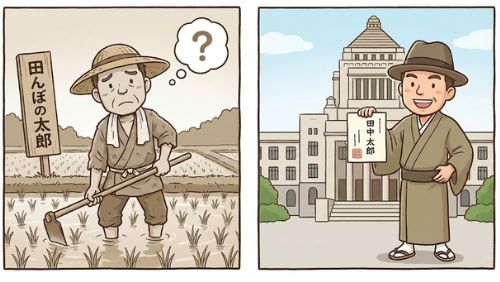
Until the early Meiji era, ordinary folks—farmers, fishermen, merchants—weren't officially permitted to use surnames. That privilege belonged to samurai, nobility, and a handful of wealthy village headmen. Everyone else was just 「田んぼの太郎」or「川沿いの花子」—Tarō from the paddies, Hanako by the river.
(Some families did have informal house names(屋号)they used privately, but that was a different matter.)
Then the Meiji government decided everyone needed a registered family name. Permission came in 1870, and by 1875, registration was mandatory.
Millions of people looked around. Rice field? Mountain? Big tree? Good enough.
And that, in a nutshell, is why names like 田中 "middle of the rice field," 山本 "base of the mountain," and 小林 "small forest" are everywhere today. Many aren't ancient clan names—they're descriptions of where someone's house happened to be. Some families simply registered the informal names they'd been using quietly for generations. Others invented something on the spot.
The 藤 Connection
Now here's where it gets interesting.
If you see 藤 in a name, that's a different story. It often traces back to the 藤原 clan, one of the most powerful families in Japanese history. They basically ran the country during the Heian period. Over centuries, branch families split off and added location prefixes: 佐藤, 伊藤, 加藤, 近藤.

So if you meet a 佐藤さん, their family might have samurai roots.
Or—and this is important—a farmer in the 1870s thought 藤原 sounded prestigious and grabbed a piece of it. There was no fact-checking. You liked a name? It was yours.
This means many Japanese people today genuinely don't know whether their "noble-sounding" name traces back to actual nobility. Family records(家系図)exist for some, but plenty were lost, destroyed in the war, or were creative fiction from the start.
Some names carry more historical weight than others.
源 and 平 are historically traced to imperial princes who were removed from the line of succession centuries ago. 徳川? Those shoguns. 織田, 武田, 上杉? Famous warlord clans. Of course, the surname alone doesn't prove descent—but these names do turn heads.
Then there are Okinawan names—比嘉, 金城, 新垣—immediately recognizable because Okinawa was its own kingdom(琉球)with separate traditions. These really stand out on the mainland.
Because so many families independently chose geographic names, Japan ended up with an unusual concentration at the top. The top ten names cover roughly 10% of the entire population. In the U.S., the top ten cover around 4-5%.
One more thing: 鈴木, the second most common name, has nothing to do with geography. It originally comes from rice straw piles associated with Shinto harvest rituals. Families connected to these rites took the name, and it spread from there.
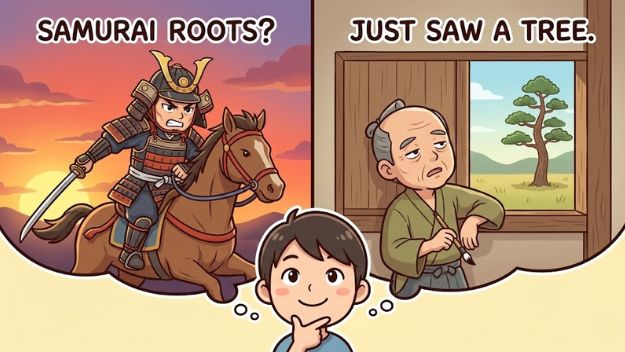
So next time you see a Japanese family name, you're looking at a little historical puzzle. It might reveal something about someone's ancestors, their homeland, their social class—or just what their great-great-grandfather saw outside his window when he needed to fill out a government form.
Kind of like "Boutwell."
Or, for that matter, "Dirty Toilet."
とても面白い
Really interesting! ありがとうございます!🙂
It is!